Thursday, December 22, 2016

Warhammer 40k: Retrospective

For the first time in a long time, I suffered the greatest of all creative issues: burnout.  When you fin that you just can't bring yourself to work because you either over-committed yourself, or if you're over-stressed, then you might burnout, and I had a pretty bad one.  It definitely affected my output for this semester, but finding a solution to a little while.
The first step, as cliche as it sounds, is to admit there's an issue.  If you don't, then the problem goes unsolved forever.  The second step, in my experience, is to find another small project to work on, just to give your mind a creative break.  I found that painting for a little while actually worked as a mental vacation.  Below is one of the paintings I did this semester.


Warhammer 40k: Polish

Part of what makes a finished project, is polishing it up at the end.  However, because Warhammer relies so heavily on perfect mechanics, we have to playtest and re-balance constantly.  Over the course of the semester, I really designed some of the most broken, over powered levels, but with the help of playtesting, I was able to polish them to a finished state.

Warhammer 40k: Tactical Objectives

Part of our finished product was the production of Tactical Objectives.  These cards are special situations in which you can earn extra points.  Since the Fungal Orks are primarily based on infecting others, much of their Tactical Objectives are as well.  We also printed them and cut them out ourselves in order to have a better overall project.


Wednesday, December 21, 2016

Warhammer 40k: The Death Mire


Perhaps the most infamous level I've ever designed, the Death Mire is probably the one we playtested the most.  I heard about certain planets in the Warhammer universe called Death Worlds, which are deadly, that it's impossible for normal people to live on it.  Only Space Marines are able to even set foot on this world.
Thinking that this might have a good RGN factor to it, I created a scenario on the death world Sauria, which is filled with dinosaurs.  And based on this, the players have a great chance of stepping in a deadly situation.  But it was too deadly, so it was rebalanced and rebalanced to get it just right.


Warhammer 40k: Burning Metal

It's my personal belief that Warhammer 40k Orks are more like the villains in a Mad Max movie than any other orcs in fiction.  Their penchant for soldering on random bits of metal and their love of violence is reminiscent of Immorten Joe.


So with them being very Mad Max, I wanted to have a scenario that would reflect that.  Eponymously named Burning Metal, it's high octane violence in the desert.
I did make a new rule called Sandstorm!, where a sandstorm is rolling.  Originally, the sandstorm would just roll in unexpectedly, but after some feedback it was changed to a gradually increasing effect, where the results would increase in damage over time.

Warhammer 40k: Secrets of Aurelia and Ambush

After iterating on the Snowed In story line, I came up with the idea of G'mork seeking an human STC.  For those unaware of deep Warhammer 40k lore, an STC is object created during the golden age of humanity to act as a mobile library of all of humanity's knowledge.  It was used for early space colonies who would travel for centuries in space, then land on a distant world and use the ship and STC to build a new settlement.

In this scenario, G'mork is trying to rebuild this STC because they are considered to most invaluable thing in the galaxy.  Access to all of humanity's secrets would give anyone a massive advantage.


Warhammer 40k: Snowed In

The first few level designs I did were based upon interesting worlds and interesting climate conditions.  The Warhammer universe is full of dangerous planets that are difficult to survive on.  You would definitely need a super human race to conquer planets filled with demons and dinosaurs.  One such planet is Aurelia, which was once the home of a human hive city, long since abandoned, and frozen over.


G'mork journey's to Aurelia to loot the abandoned hive city for any ancient human tech.  However, after running into the Imperial Guard, they accidentally set off an avalanche.
A definite through-line of all my levels are environmental disasters, because having the opportunity to take out a lot of models from a freak avalanche is pretty fun for Ork players.

Wednesday, October 19, 2016

Warhammer 40k: The Cave

I was given the role of Level lead, which in this case means that it's my team's role to come up with the various battle scenarios that we'll be testing.  My first idea was play with the terrain of a map, what could I do in a level that hasn't been done before.  I added 3 rock columns that couldn't be fired over, but they could be toppled.  If destroyed, they could fall and flatten an entire unit, if the scatter die was lucky.  Below is the map for the cave.


Warhammer 40k: G'mork and his Army

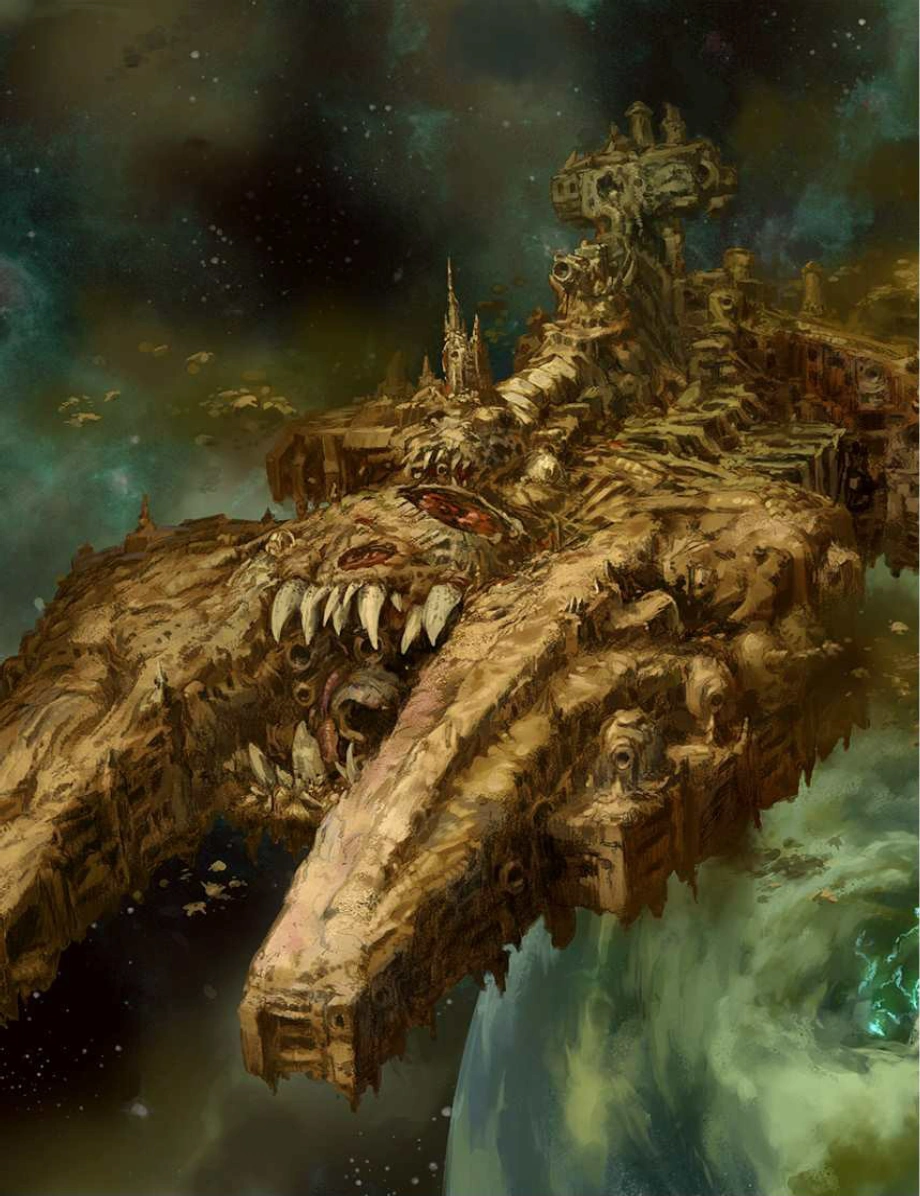
My first task was to write out the lore of how G'mork obtained an army.  It was agreed upon that G'mork received his power from Warp, an alternate reality that allows FTL travel but is also infested with demons.  While traveling too close to a Warp storm, G'mork was captured by a demon, tortured, and infected with a rot.  However, this rot mutates him, allowing him to infect others via spores.  He escapes on a demonic ship (like the one pictured below), and goes on to try and obtain an army.  You can read my contributions to G'mork's story below.


G’mork had successfully escaped the Eye of Terror, with new found abilities and a small army in tow.  However, he was quickly intercepted by an Ork ship that had wandered too close to the Warp rift.  The Orks were drawn to it, seeing it as a relief to their boredom rather than a trap waiting to be sprung.  Nurgle’s ship looked more like a decaying corpse of some giant animal than something that was space worthy, so the Orks thought of it as an easy victory.  
Boarding the ship was no easy task, as most of the hatches seemed to be grown over by some greenish, rotting material.  A pungent, swamp-like odor hung in the silent air as the orks explored the corridors; with the only light coming from luminescent mushroom bulbs that glowed a dim, sickly yellow.  Undeterred by this, the Ork pushed forward, delving deeper, and deeper into the ship.  At the back of the party, one Ork peered into a small crevasse, and noticed a body shoved awkwardly in the crack.  He tapped the corpse with an axe, to make sure it was dead.  But at the slightest touch, the body burst open and sprayed him with bloody mist.  He stumbled back, but quickly found his footing.  After burying his axe in the corpse for spraying him, he rejoined the party.  

A thought began to take form at the back of this ork’s mind, an insistent, irritating thought.  A name began to surface, G’mork.  All at once, the holy spirit of Gork and Mork came upon him; and a grand vision of a Great Waaagh! flooded his head.  If orks could cry, he would certainly have been brought to tears.  It was at this moment that he knew what his purpose was, now he just needed to share it.  He grabbed the ork nearest to him, and took a deep breath in.

Warhammer 40k: G'mork

Unfortunately, my pitched race wasn't chosen, but we did choose an equally good race.  The whole idea is that orks developed an evolutionary trait where fungus would link them all together, allowing them better coordination and and sharing psyker abilities.
With more iteration, we developed the idea of a super ork, the very incarnation of the ork gods, that would lead this race.  This ork was meant be the ork that united all orks everywhere, the Emperor of Man kind of ork.  But then we remembered that these were the orks, and everything about them is over the top, so we decided to make this super ork a gretchen.
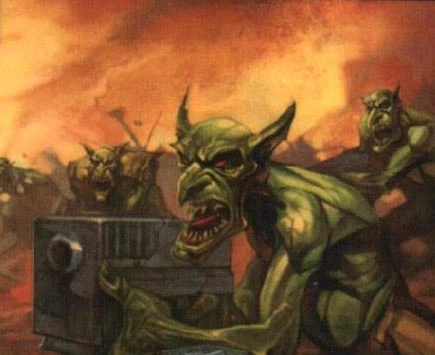
A gretchen is basically a space goblin, a subspecies of ork that is much smaller.  Gretchens function as meanial workers and are the lowest rung of ork society.  We figured that it would be hilarious if the ultimate Emperor of Orkkind was this little put-upon goblin.  His name was a fusion of Gork and Mork, the ork gods.  He is G'mork, avatar of Gork and Mork, both brutal and cunning.


Warhammer 40k: SPACE RATS

Last semester's Warhammer 40k class took a race that existed in regular, fantasy Warhammer, and brought it into the 41st millennium.  The reasoning behind this was to use many of the preexisting units, and just upgrade them, i.e., half the work is already done.  So I decided to take a similar approach.
The Skaven are a race of verminous rats that spread out and take over urban areas, basically, smart rats.  So the bulk of the idea was to just bring this race into Warhammer 40k.  Though, since I'm not to keen on every race being grimdark, I'm changing the Skaven to a more peaceful race, or at least peaceful by Warhammer 40k standards.  Before humanity descended into ultra religious dogma, they roamed the galaxy as explorers, so the lore of my Skaven are that rats stowed away on board, and gradually evolved alongside humans.  Now, they're a heavily expansionist race that see themselves as the proper successors to mankind.


Warhammer 40k: The Tau

Our enemy for this week were the Space Marines.  Ultimately, when we design a race, we have to test it against them, because they're the most balanced.  We introduced flying mechanics, but we still lost, because orks always lose, but I still had fun.  I'm looking forward to next week when we actually pitch our races next week.  For my race, I'd like to pitch something like the Tau.

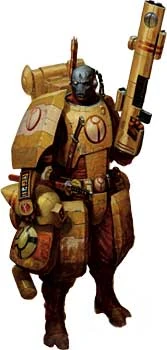
The Tau are a race of xenos(aliens) that specialize in mech warfare, that is, they use giant robot exoskeletons to fight.  But the most interesting part of them is that they're probably the most morally superior faction in the entire Warhammer 40k canon.  They believe in a concept called the Greater Good, which means that they will take any action to make sure that the greatest number of people survive.  They're not xenophobic or ultra religious like the humans, nor violent or capricious like the orks and eldar.  The catch is that you might be killed if you don't agree with the greater good.
I'd like to design a race that is more morally gray and non-monolithic than the other Warhammer races.  It's almost a personal rule, that I will not design a race with a single good or evil alignment.  There's just to many interesting stories you can tell with a morally gray race.


Warhammer 40k: St. Mork's 'Eelin Center of Death

This week, as I was reading more ork lore, I quickly realized that orks are the most ridiculous faction in the Warhammer 40k universe.  They consistently misspell words, like leaving of the "H" at the start of Hard Case, making it read like heavy cockney accents.  They literally believe that colors have an effect on their weaponry, red to make things faster, and yellow for larger blasts.  I've been told that ork technology doesn't work, but since they're the most powerful psykers in existence, simply believing that it works, makes it work.
I admire the designers who came up with the space orks, as their lore is so different from other races.  I can almost imagine that orks were created to be ridiculous to alleviate the dark and gritty tone of the rest of the game.  If Games Workshop were sectioned off, the Orks department would certainly be the most fun to work in.
Having realized that Orks do almost nothing seriously, I let my mind run really wild with the possibilities.  Our Ork army had a hospital theme, because I thought it would be funny to juxtapose these ultra violent aliens with a healing center.  We also drove our trucks straight into the enemy, and when that truck crashed, we crashed another truck in that truck.


Warhammer 40k: The Orks

We'd started the Warhammer 40k design class by picking the race we'd like to play.  I wasn't very familiar with Warhammer 40k; I know that the universe is incredibly grimdark, that is, a setting so dour that most people are racist, genocidal, violent, lunatics.  I was informed that Orks were considered "fun mode", so not knowing the game, I choose them.  If the point of any game is to have fun, then why not choose the "fun" option.
The other factions we could've chosen were the Space Marines, the xenophobic humans who worship the Emperor of Man, who I personally think is a unrealistically perfect character.  The Eldar, who are more or less space elves, and the Tryanids, which is a hive of space bugs.
Learning the actual game was difficult, as there are so many phases, dice, and units to keep track of, but playing as the orks simplified it a bit.  Our first opponent was the Eldar, to which we lost to.  Apparently, orks don't win a lot, but at least it was fun to WAAAGH!


Thursday, May 19, 2016

Dungeons and Dankness Part 16: Before the End

I think that some of my best content work has come out of this class.  I was given the opportunity to go pretty wild with the stories I wanted to tell, even if we didn't have time to play them.  Perhaps the most valuable lesson I learned for writing interesting content is look for inspiration outside of D&D.  If we emulated standard D&D tropes and cliches, our mod would have been the most derivative thing ever.  Luckily we had the Inner World as a jumping off point, because it is such a weird and fantastic place.  
I started off wanting to emulate middle and far eastern cultures, but I think I tried to be too close reality.  I'm glad that we instead with something a lot more creatively stimulating.  Below is my original map for my mod idea.


Wednesday, May 18, 2016

Dungeons and Dankness Part 15: The Big Finish

Because of the length of the campaign, we had to skip over a fair amount of the story in order to finish on time.  Adventures that could've been include:  Hojo's Matinee, the party is captured by an insane playwright who forces them to kill each other in his demented plays.  Moonshine Massacre, a potion's lab explodes, leading to a confrontation between two feuding families.  The Lord's Last Dinner, when the players are invited to a Lord's dinner, but a sudden murder stops the meal, dead.  But there's more to this mystery than meets the eyes.  Although it's sad that these quests where sacrificed for time, I understand why they had to be cut.


We had to skip a lot of fun adventures in order to finish, but our DM gave us a synopsis of what happens in between.  We arrive at the final dungeon to face the Entropy, who I imagined as a living galaxy, constantly be born, living, and dying in the span of moments.   Our party ended up taking on Droge instead and got the bad ending.

Dungeons and Dankness Part 14: What killed the dinosaurs?

We started playing our mod this week, with me playing as our Wizardess, which I was happy with.  I wanted to avoid combat as much as possible because it tends to really drag in D&D sessions.  I'm a bigger fan of socializing and puzzle solving than combat, so I actively tried to use my spells in more creative ways.
My biggest moment was when our party washed up on beach and were attacked by a t-rex.  Realizing that I couldn't do a whole lot of damage on my own, I thought of a plan.  I lured the t-rex into the sea with a mesmerizing spell, then as soon as he was neck deep, I froze the water around him.  With the dinosaur frozen, our Witch doctor (played by Emil Harmsen) set upon him with vengeance.  Upon freezing the t-rex I shouted this:


It was my best moment in Dungeons and Dragons ever.

Dungeons and Dankness Part 13: The Forest Giant

I'm a big fan of semi-human monsters.  Not necessarily monsters who are part human and part something else, but monsters and characters who have similar anatomical features.  A method of creating striking character design is to take normal human anatomy, and push it.  
When I had the opportunity to create a new monster for our DnD campaign, I leapt at the chance to design something new. 
The Forest Giant is semi-human looking boulder supported by long limbs.  I wanted to create something otherworldly, something ancient, something that might rise out of the forest floor.


Forest giants wander in the deep forests of hills and mountain slopes, usually alone.  Resembling more like giant boulders with gnarled roots rather than large humans, forest giants are more different from normal giants than they are alike.  It’s postulated that Forest Giants are actually a speciation of treants, but with rocks incorporated into their body.

Thursday, April 14, 2016

Dungeons and Dankness Part 12: Summer Nights and Autumn Leaves

Hojo is a Pirate King who controls much of the underworld of Korotiku.  Styling himself as a gentleman and noble, he has recently taken up play-writing and poetry.  Even then, his sadistic nature shows, as when a character gets hurt or dies in the play, they dies for real.  Hojo believes that an actual life and death situation will create the most genuine acting.


His play, titled Summer Nights and Autumn Leaves, is a short, two act play that draws inspiration from Romeo and Juliet and  Othello.  The chief characters are Veronica, the guard of Prince Cosmo's palace, the thief Giovanna, and Giuseppe, the clown.  Veronica and Giovanna kill each other over Cosmo's love, and a distraught Cosmo leaps off the highest set on stage.

Two of the players act out the characters Giovanna and Cosmo while an NPC named Othella plays Veronica.  Othella, like hundreds of actors before her, has been forced to kill her fellow thespians in Hojo's  theater.  The players will have to choose if they will try to set her free while escaping, or defend themselves in this dark play.

Wednesday, April 6, 2016

Dungeons and Dankness Part 11: Spring Break

Over Spring Break, I mostly worked on re-editing my main quest outline document, but I also came up with a brand new monster for our campaign: The Water Wizard.


Coming up from the briny deeps is the legendary Water Wizard who swings a deadly anchor.  However, this anchor is enchanted.  Instead of being dragged in water, the anchor drags water out of the sea, creating a flail of water.


Dungeons and Dragons Part 10: The Lord's Last Dinner

This week, I got the privilege to playtest one of the stories I wrote for the campaign.  I wanted to as many of the player's adventures to have as little combat as possible.  The players will probably be fighting a ton of monsters and bad guys in side quests and random encounters, so I wanted them to have a chance to flex their non-combat skills.


I wrote the outline to a whodunit where the players eat dinner at a lord's palace, only for the lord to die halfway through and the blame being placed on the players.  I'm very good at writing mysteries and I hit writer's block trying to come up with all the clues, luckily, our dungeon master Ian Ehlers managed to come up with a great mystery on the fly, and gave me inspiration for various clues.

Dungeons and Dankness Part 9: Driders and Pirates

An NPC, or "Non-Player Character" is someone in a game who is not the player nor an enemy.  They exist to either be important characters the player interacts with, a vendor for supplies, or just and extra to populate the world.  It was my task this week to stat out and give backstories to the most important characters that the players will be interacting with.
The document can be found here.


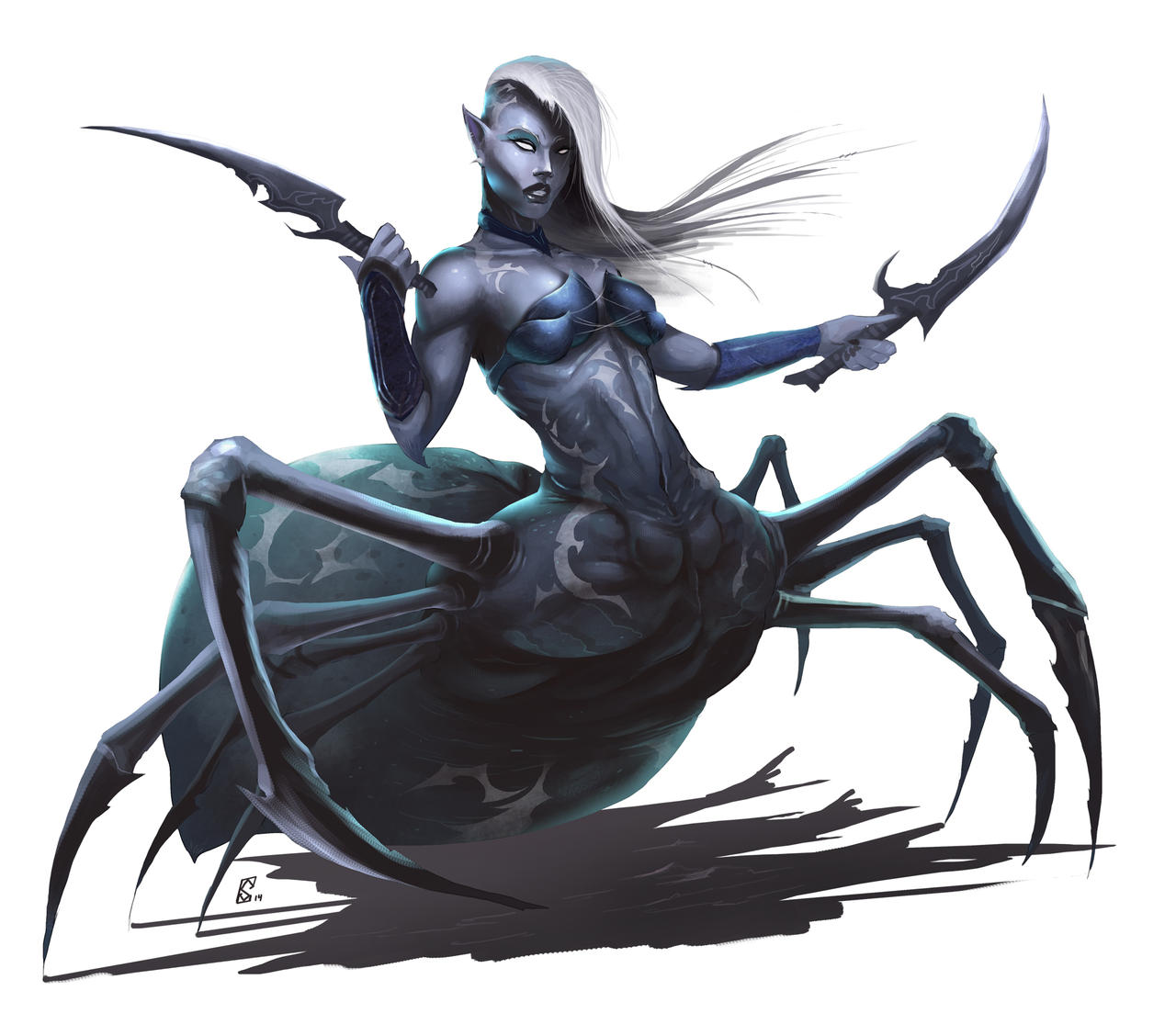
My two favorite characters to work on were Malvyr the Drider Librarian, and the Pirate King and playwright.  Malvyr was a promising drow warrior who failed her trials and was cursed to become a half-spider creature.  Exiled, she wandered aimlessly until she heard about a spider god named Korotiku.  She thought that if she killed this false spider god, she would be redeemed in the eyes of Lolth (the drow spider goddess who cursed Malvyr).  But when she saw Korotiku in all his glory, she was frightened and surrendered without a fight.  Korotiku, being a very benevolent god, took Malvyr in, making her his ward and Head Librarian of his vast library.


I wanted a sort of Jabba the Hutt kind of character for our campaign, someone who was incredibly vile and sadistic, but who also felt very highly of himself.  Initially, he would've had gladiatorial fights in his palace, but I didn't think this fit his "upper class" ego.  So now he writes plays that he forces actors to participate in, but whenever there's a fight or death scene, the actors are expected to actually kill each other.  Hojo's sadistic mind believes this add more believability to his violent plays.  I think this fits more with how he wants to be scene, plus it's not as cliched as gladiator fights.

Thursday, March 10, 2016

Dungeons and Dankness Part 8: The Middle Part

During this whole week I spent working on the entire middle part of the story.  From when the players first enter into the Inner Realm of Arkina to the the last episode.  The story is split into 5 episodes, each of varying length and difficulty, but the basic plot line remains the same.  I won't spoil much here, but you can read all the stuff I wrote here: Main Quest Line.


I will talk a little about one of my favorite missions that I wrote though.  During the second episode, the players must find information on why the Arkinans attack, so they trade service for info with Hojo, a pirate lord.  All he asks in return is that they act out a play he wrote, little do they know that he has other plans for them.

Dungeons and Dankness Part 7: Korotikua

This week, I jumped onto the Hub City feature, our Hub City being one of our big settings in the campaign.  The city of Korotikua is massive trade city with much of it's economy based on fishing.  This is the city the players will visit first and perform the majority of their missions in.


The above is a quick map I drew up in class, which I later took and superimposed some district boundaries.  The largest ward is the Foreign Quarter, where thousands of immigrants from all over Arkina was squished together.

Wednesday, March 9, 2016

Dungeons and Dankness 6: Calling All Heroes

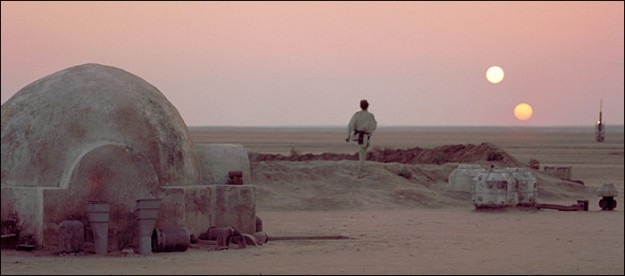
As content lead, I was charged with leading the team in creating the Outset and Catalyst.  At outset is where a character essentially starts at the beginning of the story.  It's Kokiri Forest in Legend of Zelda: Ocarina of Time, Hobbit in Lord of the Rings, and best example of all, Uncle Owen's Moisture farm in Star Wars.


A Catalyst is essentially what kicks the hero out the door.  It's similar to the Call to Adventure in the Hero's Journey, but differs in that it's usually a personal tragedy.  Luke wanted to go and explore space with Ben, but was held back by his attachment to home, but ultimately changed his mind after a tragedy.


The catalyst in our story is an attack from the Inner Realm dwellers on the surface dwellers, and a rag tag group of heroes join together.  Each has a stake in the adventure, and will journey inside the earth to accomplish it.

The Sole Survivor:  After the attack by the armies of the Inner Realm, this drow elf found that she was the only surivor in her village.  She now seeks revenge and journeys with the party to the Inner Realm.
The Eremite Mercenary: A sarcastic member of mercenary guild, his boss thought it would bring the company fame and fortune, so he volunteered his best man against his will.

The Wizardess: A sheltered sorceress who has studied the possibility of and Inner Realm.  While she has never adventured before, she is eager to prove herself.


The Banished Prince:  Once a royal in a proud desert kingdom, but banished for a forbidden love.  He now seeks to regain his honor in a daring quest to the inner realm.

The Voodoo Warlord: A washed up supervillain who seeks to regain their power in the Inner Realm.


Wednesday, February 17, 2016

Dungeons and Dankness Part 4: How to Make a Map

We planned out our epics and features, going through each one and voting on priority.  Story is our major focus right now, as the story will either make or break our campaign.  After establishing our basics, delighters, and satifiers, we started creating the map, which is simpler than you might think.


The above is our protoype map, which is split into two continents.

Making fantasy maps is pretty simple, so here's Noah Rotter's patented guide to creating fantasy worlds.

1. Start drawing continental plates
2. Determine where the continents are ramming into each other, that's where your mountains will be.
3. The furthest points from you mountain will be where the oceans are
4. Did your world have an Ice Age?  If so, then your continents are going to be cut up near poles due to glaciers.
5. Rivers always flow downhill and take the path of least resistance, i.e. rivers flow from mountains and always flow into each other.  A river will never split in half.
6. Islands are formed in many ways, the two most common are continental islands and volcanic islands.  Continental islands are formed by glaciers/rising sea level and will occur around the coast.  Volcanic islands are made by rising volcanoes, and occur where continents are splitting apart.
7. Deserts occur in bands around the 30th parallel, that is, above and below the equator.

Use these 7 helpful tips in creating your own world!

Wednesday, February 10, 2016

Dungeons and Dankness Part 3.5: Content with World Around Me

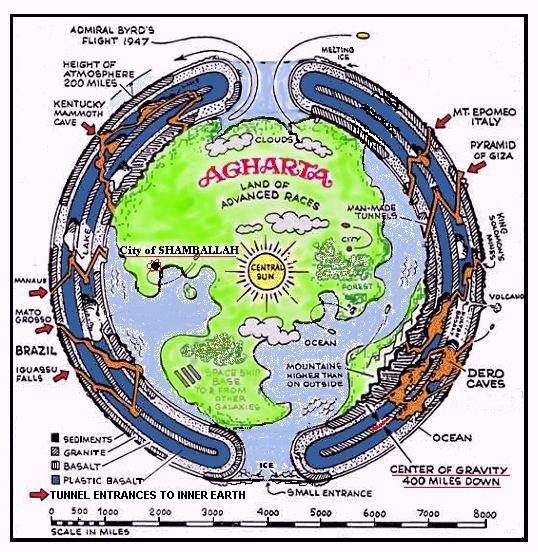
The more I think about the Hollow World, the less it makes any sense, which I guess is why it's discredited.  How does the day and night cycle work if the the sun is at the center?  Wouldn't it also mean that the inner shell is a completely uninhabitable desert?  How does gravity work if there are two centers of gravity?  Questions that make that make a plausible world impossible.  My best explanation is that some cosmic entity (a god if you will) put a minature sun at the center of the earth for reason, and is maintaining some kind of day/night cycle/gravity so that life can exist there.


I also organized the Content Bible, which gives an outline for creating a realistic world and a guide for creating a basic story outline.

Sunday, February 7, 2016

Dungeons and Dankness 3: Hollow Earth

We pitched our D&D mods, mine was based on the Indian Ocean.  I choose the Indian Ocean because it's a collection of some of the most interesting cultures in the world, which are sadly underrepresented in fantasy.  My race were four-armed descendants of gods, and my class was a witch-doctor.  Unfortunately, my mod wasn't picked, but the one that was chosen has elements of my idea.  The winning pitch was about a Hollow World, with the inner sun stealing energy from the sun.


I was made Lead Content designer, and my two assignments for the team were to browse the World Building Subreddit, and a writing challenge to gauge where their skills are at.  The challenge was to write a story about a pink square, a blue circle, and a green rectangle, and to make me care about them.


Tuesday, February 2, 2016

Dungeons and Dankness 2: The Lich

We continued on our merry adventure, but night soon fell upon us.  As we drifted off to sleep, we were startled by the sound of an attack!  Goblins poured out of the trees, but we bravely stood against them, except for our dragon born paladin, who was tripping in the forest.  I battled the goblins with my kung-fu, and by throwing a dart between the legs of my other dragon born comrade.


After the goblin attack, we settled back into sleep, that is until I sensed a dark presence.  A Lich had arrived, flanked an all sides by skeletons.  Terrified by this dark enemy, we climbed into the trees, hoping to escape his gaze.  However, one of our comrades fell, broke her leg, and was detected by a skeleton.  I leapt out of the tree, grabbed her, and booked it into the forest, with the skeleton close behind.

Thursday, January 21, 2016

Dungeons and Dankness 1: The Intimidating Monk

I've started Intermediate design where the only game we play and study is Dungeon and Dragons (Satan's Game).  Our first goal was to play and understand the game, which I have a little experience with.  I've tried to get my friends into it, but it never went past a single session.
Creating the characters is the longest and hardest portion of the game, but once you understand how simple the game actually is, then it's pretty simple.  I used my prior experience with D&D to help other players set up their character.
My character is tall, willowy Half-Orc monk named Khilana, because I like playing against stereotypes.  An adherent to the mother goddess Chauntea, she is Lawful Good and cherishes all life.  However, this did get me into trouble as I refused to allow an NPC to die, I even had to intimidate a party member to heal her for free.
We didn't do any combat, but we were still able to hold interest, and that's sign of good story.